Precision through molecular distillation
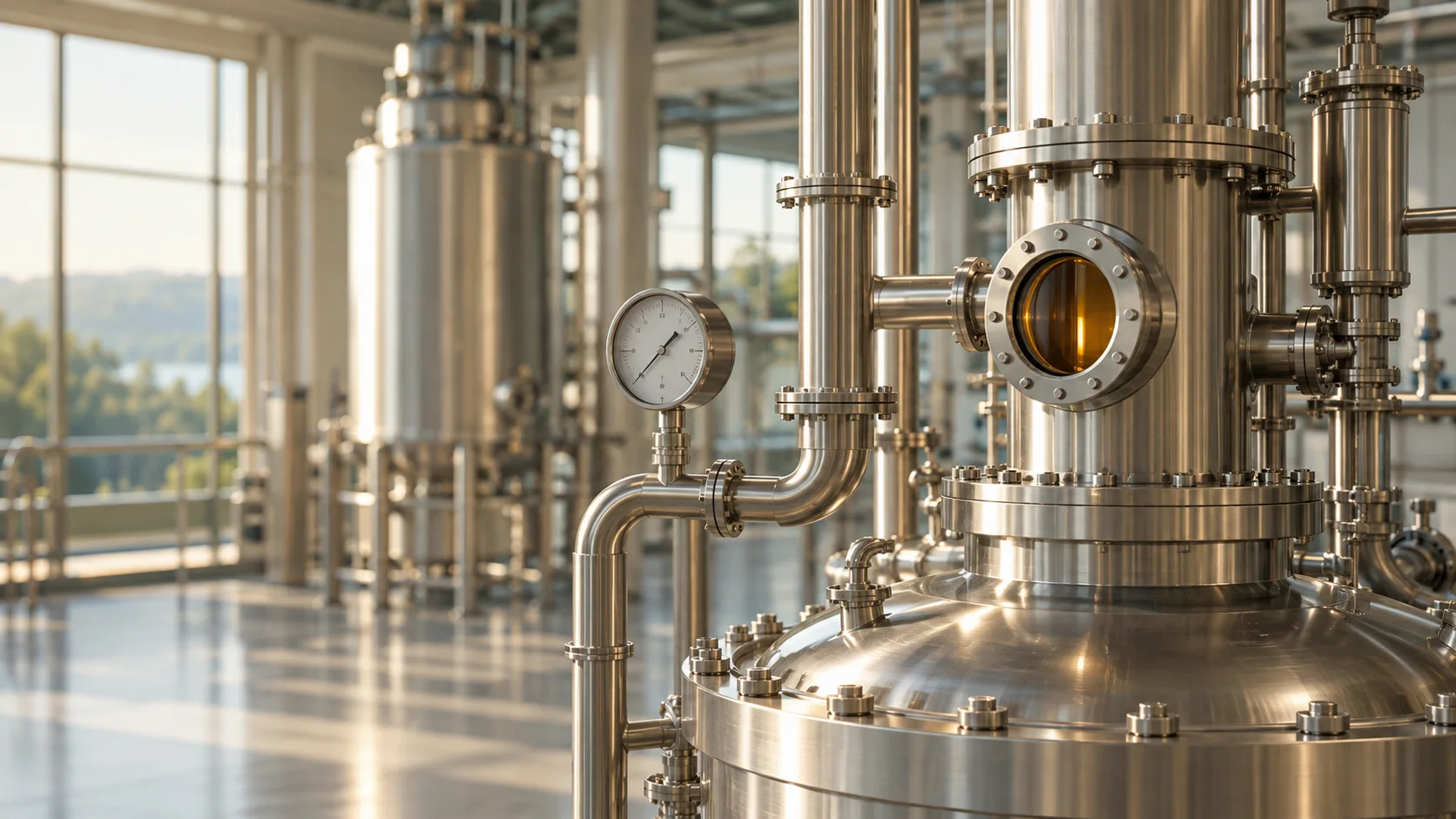
Short-path molecular distillation is where concentration actually happens: it separates omega-3 esters from the rest of the oil under deep vacuum, at a temperature low enough to leave the fatty acids intact.
Request the process documentation
Flow diagrams, typical batch data and the control points behind this stage are available on request.
Process information
| Stage | Concentration, after refining and before deodorisation |
|---|---|
| Feed | Refined and transesterified fish oil |
| Output | Concentrated EE oil from 30% up to 98% total omega-3 |
| Records | Vacuum, temperature, feed mass and cut points logged per batch |
Technical detail
| Principle | Under high vacuum the mean free path of the vapour exceeds the distance to the condenser, so evaporation happens without boiling the bulk oil |
|---|---|
| Temperature | Kept well below the point at which EPA and DHA begin to isomerise or degrade |
| Residence time | Measured in seconds, which is what protects oxidation-sensitive fatty acids |
| Cut points | Set per target ratio, so EPA-rich and DHA-rich cuts are produced deliberately rather than as a by-product |
Quality control
What is checked before and after this stage.
| Before | Feed oil assayed for fatty-acid profile and oxidation, so the expected yield can be calculated |
|---|---|
| During | Vacuum and temperature held inside a recorded band; deviation triggers a hold |
| After | Each cut assayed by GC to confirm the EPA/DHA ratio actually achieved |
| Retention | Feed and product samples retained for the batch file |
Handling and packaging
| Immediate handling | Transferred under nitrogen; no open-air holding between stages |
|---|---|
| Bulk packaging | 190 kg nitrogen-flushed drum |
| Shelf life | 24 months from production date |
| Shipping | Sea · Air · Road · Rail |
How an order runs
EPA/DHA split and total omega-3 determine the distillation cuts and the achievable yield.
Sample COA shows what the process actually delivers at the agreed cut points.
Campaign volume and packing, with lead time confirmed against the production schedule.
Download company and product files
English preview PDFs for internal review only. Company details, specifications and credentials remain unconfirmed; not approved for external distribution.
Company Profile
Brand introduction, proposed product categories and project review workflow.
Nerivanta-Company-Profile.pdfProduct Specification List
Reference product entries and an enquiry checklist; values remain subject to verification.
Nerivanta-Product-Specification-List.pdfQuality & Documentation Overview
Quality review framework and document checklist; not a certificate or test report.
Nerivanta-Quality-Documentation.pdfFrequently asked questions
Does distillation affect the fatty acid structure?
No. The esters are separated by boiling point under vacuum, so the fatty acid chains are not chemically altered by the separation itself.
Why distill under vacuum rather than with heat alone?
Vacuum lowers the boiling point, which lets the separation happen at a temperature low enough to avoid thermal degradation and isomerisation.
What concentration can be reached?
Standard output runs from 30% to 90% total omega-3, with 98% available for specific applications.
Ask about precision through molecular distillation
Tell us the specification you are evaluating and the market you supply, and we will send the relevant process data and batch documentation.